Tuesday, 22 November 2011 |
Session: Screening and Drug Discovery |
| | 09:00 | 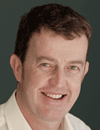 | Keynote Presentation Novel Approaches to Screening and Signaling in Drug Discovery
Matthew Cooper, Professor, University of Queensland, Australia
The potential of label-free approaches to complement or even displace traditional reporter- or label-based detection technologies has never been higher. We cover established and emerging developments in label-free detection and end-user case studies that reveal the power and limitations of the approach. |
| 09:30 | Development of Therapeutics Against Nasopharyngeal Carcinoma
Alan Khoo, Head, Institute for Medical Research, Malaysia
The talk will cover studies of the effects of several therapeutic agents on nasopharyngeal carcinoma. | 10:00 | Target Discovery for Highly Pathogenic Viruses
Sina Bavari, Chief, United States Army Medical Research Institute of Infectious Diseases, United States of America
Targeting host pathways provides an opportunity for broad spectrum targets and may eliminate the capability of organisms to generate resistance. Using knock down technologies, we found targetable host kinases and phosphatases which restrict multiple viral infections. | 10:30 | Coffee Break and Networking in the Exhibition Hall | |
Session: Biosimilars & Biologics |
| | 11:15 | Functional Interrogation of 'omics' Data
Kartiki Desai, Associate Professor, National Institute of Biomedical Genomics, India
At GIS, we combined the power of cancer genomic data with robust clinical annotation to discover druggable extracellular/cell surface proteins in advanced breast cancer. Coupled with a downstream phenotypic screen and extensive functional characterization, we identified several new targets. The strategy and outcome will be discussed. | 11:45 | Advanced Technologies for Screening Mammalian Cell Clones for Production of Monoclonal Antibodies and Recombinant Proteins
Claire Bungard, Application Specialist, Molecular Devices, United Kingdom
Monoclonal antibodies and recombinant proteins serve as powerful agents for treatment and research of diseases including infection, cancer and autoimmunity. The technologies presented allow automation and significant improvement in the cell line discovery and development processes. | 12:15 | Lunch and Networking in the Exhibition Hall | 13:30 | Poster Viewing Session | 14:15 |  | Keynote Presentation Applying HTS Techniques to Biomarker Discovery: Challenges and Opportunities
Krishna Kodukula, Executive Director, CADRE, SRI International, United States of America
Biomarkers discovery presents unique opportunities to apply high-throughput methods and a systems approach. However, significant hurdles need to be overcome to succeed. This presentation will highlight some key challenges and corresponding opportunities. |
| |
Session: Novel Screening Platforms and Technologies |
| | 15:15 | Coffee Break and Networking in the Exhibition Hall | 16:00 | Two Tales of Target-based HTS and H2L for Anticancer Drug Discovery: A Kinase and a Protein-protein Interaction
Jonathan Baell, Laboratory Head, The Walter and Eliza Hall Institute of Medical Research, Australia
Here we will outline our discovery of a screening hit and subsequent hit-to-lead medicinal chemistry for an anticancer kinase target, with unexpected results. This will be followed by a brief summary of a highly successful medicinal chemistry optimization campaign to prosecute a singleton screening hit for an anticancer protein-protein interaction. | 16:30 | High-throughput Cellular Assays using a “well-less” Plate Format
Jean Stephan, Research Senior Scientist, Genentech Inc, United States of America
| 17:30 | Drinks Reception |
Wednesday, 23 November 2011 |
Session: High Content Screening |
| | 09:30 | High-Content Screening for Small Molecule Therapeutics
Kurt Lackovic, Senior Research Officer, Walter and Eliza Hall Institute of Medical Research, Australia
The Walter and Eliza Hall Institute of Medical Research has employed high-content imaging for small molecule hit identification projects, as well as more developed lead optimization programs, for several years. Projects have included a diverse range of targets and disease types. Examples of workflow, screening formats established and successes will be presented. | 10:00 | High Content Assays for Identifying Compounds to Inhibit Human Brain Scar Formation
Mike Dragunow, Professor of Pharmacology, Auckland University, New Zealand
Meningeal fibroblasts form scar tissue in brain. To identify compounds for reducing brain scar formation we have developed a high content assay that measures the proliferation and migration of human meningeal fibroblasts after mechanical injury in a 96-well plate format. | 10:30 | Coffee Break and Networking in the Exhibition Hall | 11:15 | 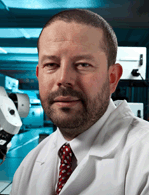 | Keynote Presentation High Content Assay to Identify Modulators of Dengue Virus Infection
Hakim Djaballah, CEO, Institute Pasteur - Korea, Korea South
Dengue virus (DENV) infections are vectored by mosquitoes and constitute one of the most prevalent infectious diseases. Current treatments for DENV infections are nonspecific and largely ineffective. Efforts to identify and repurpose approved drugs will be presented. |
| |
Session: Natural Products Screening |
| | 11:45 | Efforts to Diversify a Natural Product Library for Screening
Charlie Chia, Senior Research Officer/Chief Scientist, Sarawak Biodiversity Centre, Malaysia
Access to a rich biodiversity source could provide scientists with natural products that are unmatched in chemical diversity, complexity and biological potency for screening. A systematic approach to set up a natural product library and efforts to diversify this library will certainly aid natural product screening. | 12:15 | Lunch and Networking in the Exhibition Hall | 13:30 | Poster Session | 14:15 | Chromatographic Methods for Screening Active Compounds from Herbal Extracts
Shao-ping Li, Professor, Macau University , China
Screening of active compounds from herbal extracts using chromatographic methods based on their chemical characters, affinity and activity of target molecules. | 14:45 | Bioactive Natural Products from the Indonesian Moraceous Plant
Euis Holisotan Hakim, Lecturer, Bandung Institute of Technology, Indonesia
| 15:15 | Coffee Break and Networking in the Exhibition Hall | |
Session: Assay Development and Analysis |
| | 15:45 | Analysis of Cellular Image-based RNAi Screens Beyond Human Vision
Frederic Bard, Assistant Professor, Institute for Molecular and Cell Biology, Singapore
One of the main challenges of high-content screening based on automated microscopy is how to harness the full potential of information-rich images. We present a new method to address this and argue that image analysis in cell-based screens must go beyond human vision analytical capabilities. | 16:15 | Using Bioluminescent Technologies to Screen for Small Molecule Modulators of Cell Signaling Pathways
John Watson, Director, Promega Corporation, United States of America
| 16:45 | Translational Research Driven by High-throughput Screening Approaches
Horst Flotow, Senior Project Manager, D3 (Drug Discovery and Development)e, Singapore
The Singapore Screening Centre is the newly opened High Throughput Screening facility of the Experimental Therapeutics Centre in Singapore. A couple of infectious disease and oncology collaborative drug discovery projects with local and international partners have been initiated, which will be presented and discussed. | 17:15 | Close of Conference |
|



 Add to Calendar ▼2011-11-22 00:00:002011-11-23 00:00:00Europe/LondonScreening Asia 2011Screening Asia 2011 in SingaporeSingaporeSELECTBIOenquiries@selectbiosciences.com