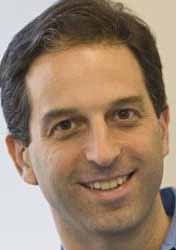
Ron Weiss,
Director, MIT Synthetic Biology Center; Professor,
Massachusetts Institute of Technology (MIT)
Ron Weiss is Professor in the Department of Biological Engineering and in the Department of Electrical Engineering and Computer Science at the Massachusetts Institute of Technology, and is the Director of the Synthetic Biology Center at MIT. He is also the Principal Investigator of the MIT Center for Integrative Synthetic Biology established and funded in September of 2013 as part of the NIH-NIGMS national centers for systems biology (cisb.mit.edu). He received his PhD from MIT in 2001 and held a faculty appointment at Princeton University between 2001 and 2009. His research focuses primarily on synthetic biology, where he programs cell behavior by constructing and modeling biochemical and cellular computing systems. A major thrust of his work is the synthesis of gene networks that are engineered to perform in vivo analog and digital logic computation. He is also interested in programming cell aggregates to perform coordinated tasks using cell-cell communication with chemical diffusion mechanisms such as quorum sensing. He has constructed and tested several novel in vivo biochemical logic circuits and intercellular communication systems. Weiss is engaged in both hands-on experimental work and in implementing software infrastructures for simulation and design work. For his work in synthetic biology, Weiss has received MIT's Technology Review Magazine's TR100 Award ("top 100 young innovators", 2003), was selected as a speaker for the National Academy of Engineering's Frontiers of Engineering Symposium (2003), and received the E. Lawrence Keyes, Jr. / Emerson Electric Company Faculty Advancement Award at Princeton University (2003). In addition, his research in Synthetic Biology was named by MIT's Technology Review Magazine as one of "10 emerging technologies that will change your world" (2004). He was chosen as a finalist for the World Technology Network’s Biotechnology Award (2004), and was selected as a speaker for the National Academy of Sciences Frontiers of Science Symposium (2005). Over the last few years, Weiss has had several major publications in journals such as Nature, Nature Biotechnology, Science and PNAS.
http://groups.csail.mit.edu/synbio/
|
|
Synthetic Biology: From Parts to Modules to Therapeutic SystemsThursday, 16 March 2017 at 12:30 Synthetic biology is revolutionizing how we conceptualize and approach
the engineering of biological systems. Recent advances in the field are
allowing us to expand beyond the construction and analysis of small gene
networks towards the implementation of complex multicellular systems
with a variety of applications. In this talk I will describe our
integrated computational / experimental approach to engineering complex
behavior in a variety of cells, with a focus on mammalian cells. In our
research, we appropriate design principles from electrical engineering
and other established fields. These principles include abstraction,
standardization, modularity, and computer aided design. But we also
spend considerable effort towards understanding what makes synthetic
biology different from all other existing engineering disciplines and
discovering new design and construction rules that are effective for
this unique discipline. We will briefly describe the implementation of
genetic circuits and modules with finely-tuned digital and analog
behavior and the use of artificial cell-cell communication to coordinate
the behavior of cell populations. The first system to be presented is a
genetic circuit that can detect and destroy specific cancer cells based
on the presence or absence or specific biomarkers in the cell. We will
also discuss preliminary experimental results for obtaining precise
spatiotemporal control over stem cell differentiation for tissue
engineering applications. We will conclude by discussing the design and
preliminary results for creating an artificial tissue homeostasis system
where genetically engineered stem cells maintain indefinitely a desired
level of pancreatic beta cells despite attacks by the autoimmune
response, relevant for diabetes.
|



 Add to Calendar ▼SELECTBIOenquiries@selectbiosciences.com
 2_150x75.png)