

Mary-Beth FiskPresident & COO, South Texas Blood and Tissue Center In 2011, Mary Beth Fisk was appointed President & Chief Operating Officer of the South Texas Blood & Tissue Center. She oversees all operations of the Center to include a full service tissue bank, blood services, GenCure operations to include tissue, marrow and Peripheral blood stem cell collection/processing program, the Texas Cord Blood Bank, as well as oversight of support services such as IS/IT, QA, and Communications departments. |
Ulf LandegrenPrincipal Investigator, University of Uppsala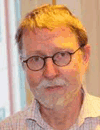 Ulf Landegren received his MD and PhD in Uppsala, Sweden, before working with Lee Hood at Caltech for five years. Back in Uppsala he now is professor of molecular medicine where his research is focused on developing and applying advanced molecular tools for analyzing macromolecules and their functions in body fluids and in situ. Examples of techniques from his lab include the oligonucleotide ligation assay (OLA) and padlock probes for measuring and distinguishing specific DNA and RNA sequences, and proximity ligation for highly sensitive detection of proteins or for measurement of interacting molecules. |
Pamela PinzaniTechnical Coordinator, University of Florence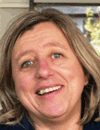 Pamela Pinzani graduated in 1985 from Florence University in Italy discussing a thesis at the Faculty of Biology. After post-degree periods as visiting scientist at the University of Medicine in Lubeck (Germany) and at the Dept. of Hormone Research of the Weizmann Institute of Science (Rehovot, Israel), she worked on the application and development of immunological methods with non-isotopic tracer and on the optimization of bioluminescence and chemiluminescence assays to investigate urinary metabolites of steroid hormones and proteins and for the use of the enzyme luciferase as reporter gene. More recently she demonstrated a special interest in molecular technologies for the optimization of real-time quantitative PCR protocols to assess the clinical significance of altered gene-expression profiles in the context of human solid tumors. Moreover she focused her studies on the blood compartment as a source of biomolecular markers to be used like diagnostic and prognostic parameters. In this context she developed methods for the measurement of tumor-related markers in cell-free plasma DNA and for the detection of circulating tumor cells (CTC) in the peripheral blood of oncological patients. She was involved in the organization of 6 courses or International meeting on Bioluminescence & Chemiluminescence Applications from 1993 to 1998 and of 10 courses or meetings on real-time PCR from 2000 to 2010.She participated as a speaker to about 30 International Scientific Meetings. She is author of about 75 publications in International peer reviewed journals, 30 papers included in national and international books and 20 manuscripts published in national journals. |
Kurt ZatloukalProfessor, Medical University of Graz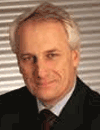 Kurt Zatloukal’s research work focuses on molecular pathology of metabolic liver diseases and cancer. He coordinated the preparatory phase of a European biobanking and biomolecular research infrastructure (BBMRI) within the 7th EU framework programme. BBMRI should provide access to high quality human biological samples to enable future needs of large genetic epidemiology and sequencing studies. In this context it is crucial to establish Europe-wide harmonized processes and quality criteria that are compliant with the requirements of latest -omics technologies as well as with ethical and legal regulations. Furthermore, he leads in the FP7-funded large integrated project SPIDIA the development of new European standards and norms for tissue-based biomarkers, and leads the medical platform of the FET Flagship project IT Future of Medicine. |


