

Stephen BaylinDeputy Director, Johns Hopkins University School of Medicine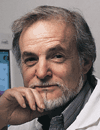 Stephen B. Baylin, M.D., is deputy director of The Sidney Kimmel Comprehensive Cancer Center at Johns Hopkins and the Virginia and D.K. Ludwig professor of oncology and medicine. He is chief of the Cancer Biology Division and associate director for research of the center. |
Ingrid GrummtHead, German Cancer Research Center Ingrid Grummt received her PhD at the Humboldt-University in Berlin, worked as a Postdoc at the Max-Planck-Institute of Biochemistry in Munich, led a research group in Würzburg, and is Division Head at the German Cancer Research Center in Heidelberg since 1989. Her research focuses on the molecular mechanisms that regulate transcription. She serves on several scientific advisory boards and is a member of EMBO, the Academia Europea and the German Academy of Sciences Leopoldina. She has received numerous awards, including the Science Prize of the Fritz-Winter-Foundation, the Gottfried Wilhelm Leibniz-Prize and the 2010 EMBO/FE BS Women in Science Award |
Peter MeyerProfessor, Leeds University Peter Meyer has been a Professor of Plant Epigenetics at the University of Leeds since 1995. He obtained his PhD in 1986 from the University of Cologne, and worked as a Postdoc with Heinz Saedler at the Max-Planck-Institute for Breeding Research in Cologne. In 1989 he became an independent group leader at the Max-Delbrueck Laboratory within the Max-Planck-Society before moving to Leeds. His work originally focused on transgene-specific gene silencing effects in plants. His research contributed in particular to the discovery of methylation states being imposed from the chromosomal integration region onto the transgene and the induction of hypermethylation and transgene silencing by environmental stress. The research also highlighted chromatin accessibility as a hallmark for the epigenetic state of a transgene, it confirmed the presence of a cytosine methylation system in plants that targets C-residues outside symmetrical CG contexts, and it led to the discovery of an overlapping co-operative control system for CG and non CG methylation by three DNA methyltransferases. The work then shifted towards a search for endogenous epigenetic systems, identifying signal regions for de novo DNA methylation, and towards the examination of natural antisense transcripts (NATs) as regulators of sense gene expression, which led to the discovery of a novel class of small RNAs in petunia, and the identification of alternative polyadenylation and antagonistic gene expression as evolutionary strategies to avoid antisense effects. In his recent work, he uses plant mutants to compare plants and mammalian DNA methylation functions. |


