

Jean BoyerAssociate Research Professor, UPenn Medical Center Jean Boyer obtained her Ph.D. from Rutgers University. She is currently a Research Associate Professor of Pathology and Laboratory Medicine at the University of Pennsylvania. Dr. Boyer has been instrumental in developing DNA vaccines for HIV-1. She was lead author on the Nature Medicine paper that demonstrated DNA vaccines were capable of suppressing HIV-1 replication in the chimpanzee model and she studied the immune responses in the first set of clinical trials assessing HIV-1 DNA vaccines. She has demonstrated, using the non-human primate model, the importance of a strong CD8 proliferative response to suppress HIV-1 replication. And, most recently Dr. Boyer has begun to research the impact of chronic malaria infection on vaccine induced immune responses. Furthermore, Dr. Boyer has served as a director for the Human Immunology Core, Perelman School of Medicine, University of Pennsylvania. The core provides immunological assessment of immunotherapeutics and vaccines for infectious diseases and cancer. |
Stefan KarlssonProfessor, Lund University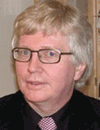 Stefan Karlsson completed his MD degree at The University of Iceland and a PhD degree from University College London. After three years as a postdoctoral fellow with Arthur Nienhuis at The National Institutes of Health (NIH), Bethesda, MD, Dr Karlsson became Chief of The Molecular and Medical Genetics Section, NINDS, NIH. In 1995 he was recruited as a full professor to Lund University Hospital, Lund, Sweden where he is currently the head of the division of Molecular Medicine and Gene Therapy. Dr. Karlsson focuses his work on the regulation of hematopoietic stem cells and the development of stem cell expansion and gene therapy of hematopoietic stem cells. |
Herman WaldmannProfessor, University of Oxford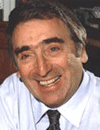 Herman Waldmann is currently (since 1994) Professor of Pathology and Head of the Sir William Dunn School in Oxford. He qualified in medicine in 1971, and then began his scientific career in Cambridge where he studied mechanisms by which cells of the immune system could interact to mount immune responses. During this period he developed new methods of measuring the frequencies of cells specific for antigen. This early work led him to become interested in immunological tolerance and achieving tolerance for therapeutic purposes. |


